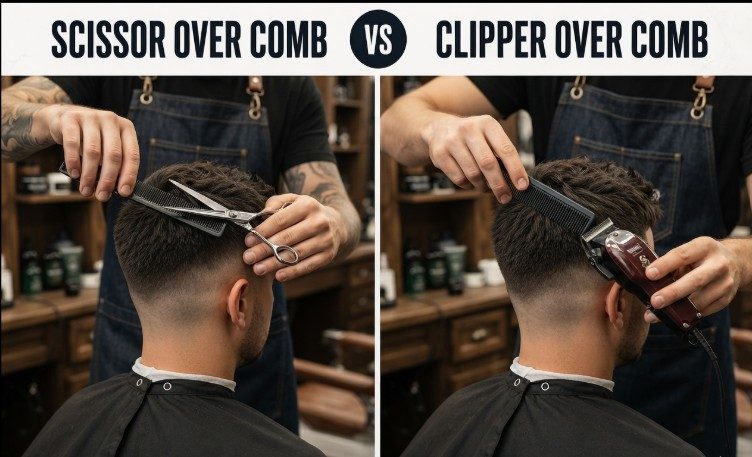
Scissor Over Comb vs Clipper Over Comb: What's the Difference, and Which Is Better?
By Natasha Shchukina, LEAD ARTIST at The Groom House – Last updated July 2026
Scissor over comb and clipper over comb both blend hair over a comb, but they are not interchangeable. Scissor over comb cuts strand by strand, so it gives softer blends, keeps more natural movement, and suits medium-length and classic styles. Clipper over comb sets one uniform length over the comb, so it is faster and cleaner on shorter cuts, tapers, and heavy bulk removal. Most good haircuts use both -clippers to build the shape, scissors to finish it.
In this guide
–The quick comparison
–What scissor over comb actually is
–What clipper over comb actually is
–The real difference (and who wins where)
–Best technique for your hair type
–Best technique for your haircut
–Can a barber use both?
–How we do it at The Groom House
–FAQ
Scissor Over Comb vs Clipper Over Comb: Quick Comparison
Scissor over comb
Clipper over comb
Tool
Cutting / blending shears + barber comb
Clippers (no guard) + barber comb
How length is set
By hand, strand by strand, at any angle
By comb position + blade lever; one uniform length
Blend
Soft, gradual, hard to see where lengths change
Clean, but the transition sits at a more defined line
Best lengths
Medium and longer; classic, textured styles
Short sides, tapers, crops, heavy bulk
Speed
Slower and more deliberate
Fast; removes weight quickly
Grow out
Softens as it grows; fewer visible lines
Weight lines can show sooner
Neither is ‘better’ in the abstract. The right choice depends on your hair, your style, and how you want it to look three weeks from now.
What is the scissor over comb technique?
Scissor over comb is a traditional method where the barber lifts a section of hair on a comb and cuts only what sits past the comb’s edge with shears. It sounds simple; controlling it is what takes years.
What makes it precise is that nothing is fixed. By changing the angle of the comb and the tension on the hair, the barber changes how steep or soft the blend is on every pass. Cutting strand tips – often with blending or texturizing shears to remove weight without shortening length – leaves ends that fall softly instead of sitting in a blunt line. That is why it holds its shape as it grows.
It is the technique behind most classic, medium-length work: tapers, side parts, Ivy League cuts, executive contours, business cuts, and brush-backs – the kind of men’s haircut that is meant to look tailored rather than machine-set. It is also the core of natural-looking grey blending, where a hard line would give the game away.
What is the clipper over comb technique?
Clipper over comb follows the same lift-and-cut idea, but the barber runs clippers along the comb instead of shears. The comb – not a plastic guard – sets the length, which lets the barber hit lengths between guard sizes and adjust closeness on the fly with the blade lever. Because clippers cut every strand to the same height in one pass, it is fast and consistent – ideal for removing bulk, blending short sides, refining a taper, and bridging two guard lengths without a step in between. The trade-off is a slightly blunter, more uniform finish: done well it is crisp; done poorly it leaves a visible weight line that gets more obvious as hair grows.
The Real Difference (and Who Wins Where)
The difference is not scissors vs. clippers – it is how much control each one gives, and what that does to the finished cut.
Precision & control – scissors. Shears remove only what the barber chooses, one section at a time, so each area can be corrected on its own. Clippers cut more aggressively; once it is off, it is off.
Blending – scissors. Strand-by-strand cutting softens the change between lengths until it is nearly invisible. Clippers blend cleanly in skilled hands, but the transition sits at a more defined point.
Texture & movement – scissors. Because weight is removed selectively, the hair keeps its natural flow – important on medium-length styles like a slick back or bro flow. Uniform clipper cutting can flatten that movement.
Speed – clippers. They remove a lot of hair quickly at a consistent length, which is why short styles are far faster in the chair.
Weight removal – depends. Scissors thin heavy areas gradually while keeping fullness exactly where it is wanted (great for thick hair). Clippers take weight off fast when there is a lot of bulk to lose – then often need a scissor pass to soften the result.
Grow-out – scissors. Gradual blends regrow softly, so the cut stays balanced longer between appointments. Clipper-heavy cuts can show lines around the sides and neck sooner.
Put simply: a mostly-scissor cut looks handcrafted; a mostly-clipper cut looks uniform. The best barbers do not pick a side – they know when to reach for each.
Which Technique Suits Your Hair Type?
Hair type
Scissor over comb
Clipper over comb
Thick
Controls weight while keeping shape
Fast bulk reduction
Fine
Preserves fullness and movement
Can remove too much if rushed
Straight
Soft, natural blending
Clean on shorter structured styles
Wavy
Enhances natural texture
Best kept to shorter lengths
Curly / coily
Holds curl definition while shaping
Useful for reducing bulk on short curls
Coarse
Precise shaping and balance
Efficient on dense areas
Hair type is only part of it – growth direction, density (cowlicks, a flat crown), and how you style day-to-day all change the call. That is a conversation to have in the chair.
Which Technique Is Best for Your Haircut?
Haircut
Leans toward
Why
Classic taper
Scissor over comb
Soft, natural transition that holds its shape
Side part
Scissor over comb
Keeps texture for a polished finish
Ivy League
Scissor over comb
Control over layering and movement
Executive contour
Scissor over comb
Refined, customized blending
Business cut
Scissor over comb
Fullness kept, edges clean
Slick back / brush back
Scissor over comb
Movement for easier styling
Bro flow
Scissor over comb
Essential for medium-length flow
Crew cut
Clipper over comb
Efficient short, uniform length
Buzz cut
Clippers
Uniformity is the whole point
High & tight
Clipper over comb
Built for close, cropped styles
Maintenance trim
Clipper over comb
Quick, consistent upkeep
Longer, textured, and classic styles reward scissor work; very short, structured cuts lean on clippers. See the full service menu for what each cut includes.
Can a Barber Use Both in One Haircut?
Yes – and the best cuts usually do. A common approach is to start with clipper over comb to remove bulk and set the overall shape, then switch to scissor over comb to refine the blend, soften transitions, and tailor the weight. You get the speed of one and the finish of the other. The skill is knowing exactly when to switch.
How We Do It at The Groom House
At our shop on 5th Avenue in Midtown Manhattan – a short walk from Grand Central – most of our classic and medium-length work is scissor-over-comb led, with clippers used to build the foundation.
If you are not sure which your hair needs, that is what the consultation is for.
Book a Scissor Over Comb Haircut at The Groom House
The Groom House
501 5th Ave, 14th Floor, Unit 1401
New York, NY 10017 (646) 581-7867
Frequently Asked Questions
Is scissor over comb better than clipper over comb?
Neither is universally better. Scissor over comb gives more precision, softer blending, and more customization; clipper over comb creates short, uniform cuts quickly. The right one depends on your hair and the style you want.
Why do experienced barbers prefer scissor over comb?
It gives continuous control over blending, texture, and weight, so the barber can adapt the cut to each client’s growth pattern, density, and head shape instead of working to fixed guard lengths.
Does scissor over comb make a haircut last longer?
Hair grows at the same rate either way, but scissor-over-comb cuts tend to grow out more gracefully because the softer, gradual blend hides regrowth – so many clients stretch a little longer between appointments.
Is clipper over comb easier to learn?
Generally yes. It is usually taught earlier because it produces consistent lengths, while scissor over comb takes longer to master due to the coordination and precision involved.
Which technique is better for thick hair?
Both work. Scissors control weight while keeping movement; clippers remove heavy bulk fast. Thick hair is often cut with clippers first, then finished with scissors.
Does scissor over comb take longer or cost more?
It usually takes more time in the chair because each section is shaped by hand. See the service menu for what is included in each cut.